

Simple production process of steel balls
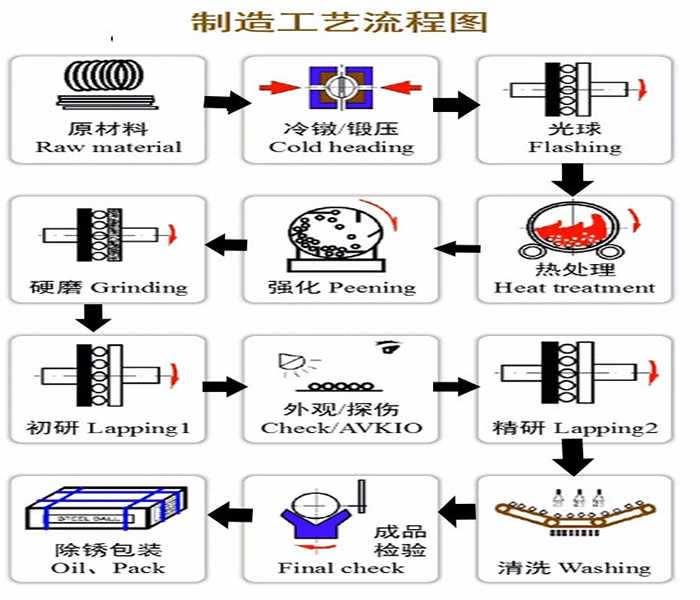
Ball blank forming → ring removal → rough grinding → soft grinding → ball blank forming → smooth ball (or filing → soft grinding) → hard grinding → fine grinding → precision grinding (or polishing) → ultra precision grinding.
Detailed production process of steel balls
1. Wire drawing: Stretch the wire to the desired diameter using a wire drawing machine;
2. Cold heading (forging): Place the pulled wire into a steel ball cold heading machine, and use the steel die inside the machine to forge it into a ball blank;
3. Lightball: Two cast iron grinding ball circular plates inside the lightball machine press and file the cold heading embryo to remove the outer ring and two poles on the embryo;
4. Soft ball: Two cast iron grinding ball circular plates inside the soft ball machine file the light ball embryo to grind it into the required ball diameter and surface roughness;
5. Heat treatment: Put the ball into a heat treatment furnace, carburizing it, quenching it, and tempering it to give it a certain carburizing layer, hardness, toughness, and crushing load;
6. Hard grinding: The grinding wheel disc inside the grinding machine pressurizes and grinds the heat-treated ball blank to remove the black oxide layer on the surface of the ball and correct the accuracy of the ball;
7. Precision grinding/polishing cleaning: Precision grinding: Grind the grinding ball embryo in the precision grinding machine to achieve the required precision and smoothness of the finished product;
Polishing and cleaning: Pour the ball into the polishing drum and rotate it, then clean the spherical surface with polishing cleaning agent and water to make it clean and shiny;
8. Appearance selection: Use manual visual inspection to check for any defects on the surface of the steel ball, and use a micrometer to measure the true roundness, batch diameter variation, and use a surface roughness meter to detect surface roughness as the final inspection;
9. Packaging: Coat steel balls/stainless steel balls/bearing steel balls with anti rust oil and pack them in cardboard boxes or woven bags.
With the development of technology, the demand for large heavy-duty bearings in the equipment manufacturing industry has further increased in terms of quantity and quality, and the requirements for the quantity and quality of supporting large bearing steel balls also need to be correspondingly increased. The diameter variation of the steel ball batch should be small, the surface roughness of the steel ball should be small, the accuracy should be high, and the difference between the core hardness and surface hardness of the steel ball should be small. The diameter of large bearing steel balls has now reached 150MM-200MM。
The manufacturing process of large bearing steel balls differs from that of ordinary specifications. The following comparison is made:
1. Manufacturing process of large bearing steel balls:
Cutting - Forging - Annealing - Turning Processing - Heat Treatment - Hard Grinding - Initial Research - Precision Research;
2. Manufacturing process of ordinary specification bearing steel balls:
Wire drawing - Cold heading - Light ball - Soft ball - Heat treatment - Hard grinding - Fine grinding;
Manufacturing process of imported bearing steel balls
1) Manufacturing equipment using imported bearing steel balls
2) Firstly, jog the hydraulic cylinder to advance the grinding plate until the bearing steel ball can be placed between the two grinding plates.
3) Install the ball outlet and keep it in a loose state. Jot the spindle to fill the space between the two grinding plates with steel balls, and adjust the ball outlet to
The ball collecting blade is tightly attached to the end face of the grinding plate (or grinding wheel) and fastened to the ball outlet. At this point, it is advisable to apply pressure to the two grinding plates to drive the chromium steel ball to rotate.
4) Close the protective cover, start the water pump, start the material tray, and start the main shaft.
5) According to the process habits of each factory, adjust the speed of the spindle and material tray, and adjust the amount of balls to ensure that the steel balls in each groove of the guide plate are evenly distributed
Uniformly distributed and not overlapping.
6) Adjust the grinding pressure, turn the pressure switch on the operation panel to the open position, adjust the pressure increasing valve on the hydraulic station panel, and raise it
Specify the pressure and lock it in each factory, and pay attention to the hydraulic system to maintain pressure during startup.
7) Under normal working conditions, it is necessary to regularly observe the operation status, pressure, and smooth entry and exit of the host.
8) When the steel ball reaches the specified size and surface quality, first reduce the working pressure, and then press the main stop button.
9) Prepare the container to remove the bearing steel ball.